Dark Triad vs Big Five: How They Relate
The dark triad covers narcissism, Machiavellianism, and psychopathy. Here's how those traits map onto the Big Five - and where the two frameworks diverge.
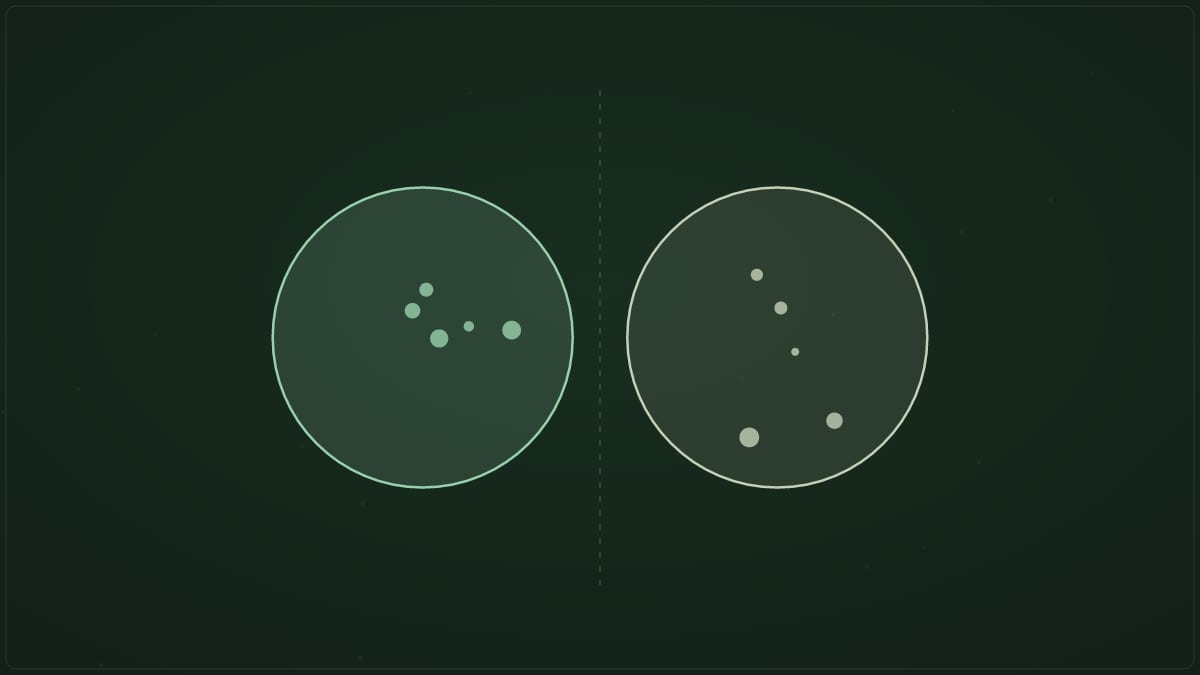
The Big Five personality framework maps the full spectrum of human personality traits. The dark triad focuses on a specific corner - the antisocial, manipulative region. They're not competing systems. Instead, the dark triad describes territory the Big Five covers, just at higher resolution.
This post explains how the two frameworks relate, where they overlap, and what each one tells you that the other doesn't.
The Two Frameworks
The Big Five
The Big Five - also called the "ocean" model - consists of five broad traits measured on a spectrum: Openness, Conscientiousness, Extraversion, Agreeableness, and Neuroticism. These traits appear consistently across cultures and are the dominant framework in personality research. Everyone scores somewhere on each dimension.
Our Big Five explainer walks through each trait in depth.
The Dark Triad
The dark triad comprises three traits: Machiavellianism, narcissism, and psychopathy. Paulhus & Williams (2002) proposed the framework in the Journal of Research in Personality to describe the callous-manipulative region of personality space. These traits cluster together empirically - people high in one tend to be higher in the others - but remain conceptually distinct.
Some researchers add sadism as a fourth trait, creating the "dark tetrad."
The Three Dark-Triad Traits
Machiavellianism
Machiavellianism describes strategic manipulation, cynicism, and pragmatic amorality. High scorers prioritize personal gain, distrust others' motives, and view social rules as tools rather than principles. They're calculated and patient, willing to deceive for advantage.
Machiavellianism is measured via the MACH-IV or through subscales of the Short Dark Triad (SD3), a 27-item assessment.
Narcissism
Narcissism involves grandiosity, entitlement, and a hunger for admiration. But it has two subtypes that matter.
Grandiose narcissism is extraverted, confident, and openly dominant. Vulnerable narcissism is anxious, defensive, and fragile - people high in this subtype react intensely to perceived slights. Both are narcissistic, but they feel different and correlate differently with the Big Five.
Psychopathy
Psychopathy in community samples - the sub-clinical kind measured in personality research - involves callousness, impulsivity, thrill-seeking, and lack of remorse. It's important to note: sub-clinical psychopathy is not the same as the clinical disorder (antisocial personality disorder). They overlap, but the criteria are distinct.
How Dark Triad Maps Onto Big Five
The following table shows how each dark-triad trait correlates with the Big Five:
| Dark Triad Trait | Strongest Big Five Link | Secondary Correlates | Notes |
|---|---|---|---|
| Machiavellianism | Low Agreeableness (r = -.45 to -.50) | Low Conscientiousness (weak) | Cynicism and manipulation drive low agreeableness |
| Narcissism (grandiose) | Extraversion (r = .35 to .45) | Openness (small positive) | Confidence and dominance pull toward high E |
| Narcissism (vulnerable) | Neuroticism (r = .40 to .50) | Low Agreeableness | Defensive reactivity and fragile self-esteem |
| Psychopathy | Low Agreeableness (r = -.45 to -.55) | Low Conscientiousness (r = -.35 to -.45) | Callousness + impulsivity create dual burden |
Agreeableness is the Strongest Link
All three dark-triad traits correlate negatively with agreeableness. Meta-analyses typically land on correlations between r = -.40 and -.55. Low agreeableness alone doesn't make someone high in the dark triad, but high dark triad almost always comes with low agreeableness.
See our agreeableness explainer for more detail.
Conscientiousness Splits the Traits
Psychopathy shows the strongest negative correlation with conscientiousness - the impulsivity and disinhibition that define psychopathy are the opposite of self-control and planning. Machiavellianism has a weaker negative correlation with conscientiousness. Narcissism, surprisingly, is roughly uncorrelated with conscientiousness. Narcissists can be highly organized and functional.
Extraversion Attaches to Narcissism
Grandiose narcissism positively correlates with extraversion (typically r ≈ .40). The grandiosity, confidence, and dominance-seeking in this subtype naturally align with high extraversion. This is the narcissist people notice.
Vulnerable narcissism, by contrast, loads onto neuroticism, not extraversion.
Check our extraversion guide for context.
Neuroticism Attaches to Vulnerable Narcissism
Vulnerable narcissism shows a positive correlation with neuroticism (r = .40 to .50). This subtype involves defensive reactivity, hypersensitivity to criticism, and anxiety about self-image.
Psychopathy is more complex. Primary psychopathy - the callous, unemotional type - tends toward low neuroticism. Secondary psychopathy - impulsive, hostile, and reactive - tends toward higher neuroticism.
Openness Barely Moves
Openness to experience is mostly independent of the dark triad. There's a small positive correlation with grandiose narcissism, but nothing substantial.
What Makes the Dark Triad Distinct
The dark triad traits share variance that the Big Five alone doesn't fully capture. Jonason & Webster (2010) identified a general "dark factor" that persists even after controlling for low agreeableness. This suggests the dark triad describes something functionally different from simply being disagreeable.
Some researchers propose an evolutionary explanation: the dark triad may represent a fast, exploitative life-history strategy - a set of traits that increase short-term reproductive success through deception and manipulation, at the cost of long-term relationships and cooperation.
The practical takeaway: the Big Five describes who you are across five dimensions. The dark triad describes specifically how antisocial, manipulative, or exploitative you tend to be. They're related, but each captures something the other doesn't.
The Dark Tetrad - Where Sadism Fits
Buckels, Jones & Paulhus (2013) proposed adding everyday sadism as a fourth trait. Sadism is taking pleasure in others' suffering - not clinical sadism, but the everyday kind you see in online trolling, cruelty in competitive games, or enjoying someone's misfortune.
Sadism predicts anti-social behavior above and beyond the dark triad alone. Whether it truly belongs as a distinct trait or is simply a manifestation of low agreeableness plus low empathy remains contested in the literature.
Measurement Instruments
Different instruments measure dark triad traits at different levels of brevity:
- Short Dark Triad (SD3): 27 items, free to use in research, measures all three traits.
- Dirty Dozen: 12 items, a very quick screen.
- MACH-IV: Measures Machiavellianism alone.
- Narcissistic Personality Inventory (NPI): Narcissism-specific measure.
- LSRP, SRP-III: Community-level psychopathy measures.
For the Big Five, the NEO-PI-R, BFI-2, and IPIP-NEO are standard instruments.
Sub-Clinical vs Clinical
This distinction is crucial and often overlooked. Dark triad measures (like the SD3) are designed for community samples - normal people with varying levels of darker tendencies. They measure personality variation, not disorder.
Clinical conditions - narcissistic personality disorder, antisocial personality disorder - require professional diagnosis and much stricter criteria. A high SD3 score means your answer pattern resembles those of people studied in dark triad research. It does not mean you have a disorder.
Can You Be High Dark Triad and Still a Decent Person?
The short answer: yes, but it's complicated.
Dark triad traits describe tendencies, not destinies. Plenty of people score moderately high on narcissism or machiavellianism and live ethical, prosocial lives. Other traits and circumstances moderate the expression of these tendencies.
Conscientiousness buffers the worst outcomes - self-control can override selfish impulses. Values matter. Situational constraints matter. Social accountability matters. The traits create pressure toward certain behaviors, but they don't determine what you actually do.
Key Takeaways
- The Big Five maps normal personality. The dark triad maps the antisocial-manipulative region.
- The dark triad consists of Machiavellianism, narcissism (grandiose and vulnerable), and psychopathy. Some add sadism as a fourth trait.
- All three dark-triad traits correlate negatively with agreeableness, the strongest Big Five link.
- Psychopathy links most strongly to low conscientiousness. Grandiose narcissism links to extraversion. Vulnerable narcissism links to neuroticism.
- The dark triad shares variance beyond what the Big Five captures alone - they're related but distinct frameworks.
- Sub-clinical dark triad traits are not the same as clinical personality disorders.
Ready to See Your Profile?
Understanding these frameworks is one thing. Seeing your own Big Five scores is another. Our test, built by TheBig5, measures all five traits and gives you a detailed breakdown of where you stand.
FAQ
What's the difference between the dark triad and the Big Five?
The Big Five measures normal personality variation across five broad traits. The dark triad focuses on three specific traits - Machiavellianism, narcissism, and psychopathy - that cluster in the antisocial-manipulative corner of personality space. The Big Five is comprehensive. The dark triad is specialized, with higher resolution in a narrower domain.
Is the dark triad part of the Big Five?
Not exactly. The dark triad traits correlate with Big Five dimensions (especially low agreeableness and low conscientiousness), but the dark triad describes something more specific. You can be low in agreeableness without being high in dark triad. The dark triad adds precision and explains variance that low agreeableness alone doesn't capture.
What is the dark tetrad?
The dark tetrad is the dark triad plus sadism - taking pleasure in others' suffering. Buckels, Jones & Paulhus (2013) proposed this expansion after finding that sadism predicted anti-social behavior beyond the three core traits. It remains debated whether sadism is a distinct fourth trait or overlaps too much with low agreeableness and low empathy to warrant separate status.
Which Big Five trait correlates most with the dark triad?
Agreeableness. All three dark-triad traits show strong negative correlations with agreeableness (typically r = -.40 to -.55). Conscientiousness is the secondary link, especially for psychopathy. Extraversion attaches specifically to grandiose narcissism. Neuroticism attaches to vulnerable narcissism.
Are dark triad traits mental illnesses?
No. Dark triad traits as measured in personality research are subclinical - they describe normal variation in personality, not disorders. Clinical conditions like narcissistic personality disorder or antisocial personality disorder require professional diagnosis and stricter criteria. A high score on a dark triad measure is not a diagnosis.
What's the difference between Machiavellianism and psychopathy?
Machiavellianism is calculated, strategic manipulation driven by cynicism and pragmatism. Psychopathy involves callousness, impulsivity, and thrill-seeking with less concern for planning. A Machiavellian person manipulates deliberately for advantage. A psychopath acts with less forethought and may hurt people through carelessness or boredom, not just calculated gain.
Can you have dark triad traits and still be a good person?
Yes. Dark triad traits predict tendencies, not inevitable behaviors. Many people with moderately elevated dark triad scores live ethical, prosocial lives because other traits (conscientiousness, personal values) or situational factors constrain how the tendencies express. The traits create pressure. They don't determine action.
How do you measure the dark triad?
The Short Dark Triad (SD3) is the most common research instrument - 27 items, free to use. The Dirty Dozen is a faster 12-item screen. Machiavellianism alone uses the MACH-IV. Narcissism alone uses the NPI. Psychopathy uses instruments like the LSRP or SRP-III. These are self-report measures designed for community samples, not clinical diagnosis.
Are dark triad traits genetic?
Twin studies suggest yes, with moderate heritability. Vernon et al. (2008) found that dark triad traits and Big Five traits share heritable variance - the genetic factors influencing low agreeableness and low conscientiousness also influence dark triad scores. But heritability is not destiny. Environment, values, and deliberate choice play major roles.
What's the difference between grandiose and vulnerable narcissism?
Grandiose narcissism is extraverted, confident, and openly dominance-seeking. Vulnerable narcissism is anxious, defensive, and fragile. Grandiose narcissists seek admiration loudly. Vulnerable narcissists react intensely to perceived slights and criticism. Both are narcissistic, but they feel different and correlate differently with the Big Five. Grandiose narcissism aligns with extraversion. Vulnerable narcissism aligns with neuroticism.
Related Comparisons
- Big Five vs DISC
- Big Five vs Enneagram
- Big Five vs 16 Personalities
- Big Five vs HEXACO
- Big Five vs CliftonStrengths
Sources
Paulhus, D. L., & Williams, K. M. (2002). The Dark Triad of personality: Narcissism, Machiavellianism, and psychopathy. Journal of Research in Personality, 36(6), 556-563.
Jonason, P. K., & Webster, G. D. (2010). The Dirty Dozen: A concise measure of the Dark Triad. Psychological Assessment, 22(2), 420-432.
Vernon, P. A., Villani, V. C., Schermer, J. A., & Petrides, K. V. (2008). Petrie effect and the Dark Triad traits. Personality and Individual Differences, 45(7), 666-671.
Buckels, E. E., Jones, D. N., & Paulhus, D. L. (2013). Behavioral confirmation of everyday sadism. Psychological Science, 24(11), 2201-2209.
Muris, P., Merckelbach, H., Otis, N., & Meesters, C. (2017). The Malevolent Side of Human Nature: A Meta-analysis and Critical Review of the Literature on the Dark Triad. Perspectives on Psychological Science, 12(2), 183-204.